
Rather than increasing lead volume, lead qualification must reduce sales uncertainty. B2B enterprises that precisely define MQLs, HQLs, and SQLs, and build handoff logic between them often consistently convert leads to pipeline.
However, most B2B teams prioritize MQL volume, leaving aside the question: What is a sales qualified lead? The MQL vs SQL debate, thus, turns into a structural failure point for companies.
Resourceful Selling’s 2026 report finds that 80% of generated leads hardly ever convert into sales. Increased revenue results from better qualification rather than from more MQLs. The qualification system often breaks when the marketing team defines MQLs by ignoring sales’ input.
The qualification system is a revenue architecture decision, which must be made jointly, reviewed quarterly with evolving ICP, and defined explicitly. The lead sits in the undefined space between MQL and SQL without any clear actions from either department, and this is where most B2B pipelines break.
What Is the Lead Qualification Process, and How Does Lead Qualification Work?
A lead qualification process forms a decision logic that pushes an account from its first engagement to sales-readiness. Although most B2B teams can define qualification stages, very few of them can define transition triggers, and this gap often breaks the qualification process.
- Raw Contact → MQL → HQL → SQL → Sales Accepted Lead (SAL) → Opportunity
Each transition becomes more valuable only when it occurs upon observing a measurable commercial signal. A practical framework that avoids qualification failure flows as:
- Signal → Score → Qualify → Route → Convert
Every stage in the framework is sequential and needs a defined rule. B2B teams must follow the discipline of defining the transition trigger before naming lead qualification stages, as they can eliminate most pipeline disagreements.
Rather than rejecting a good lead, accepting a poor lead into SQL produces the most commercially expensive qualification failure.
How Does an MQL Become an HQL and Then an SQL?
Sending leads with no sales readiness is a far bigger qualification mistake than sending leads early. B2B enterprises often design their qualification frameworks that move from MQLs to SQLs, and this shortcut creates the biggest pipeline inefficiency.
How Do You Qualify a Lead?
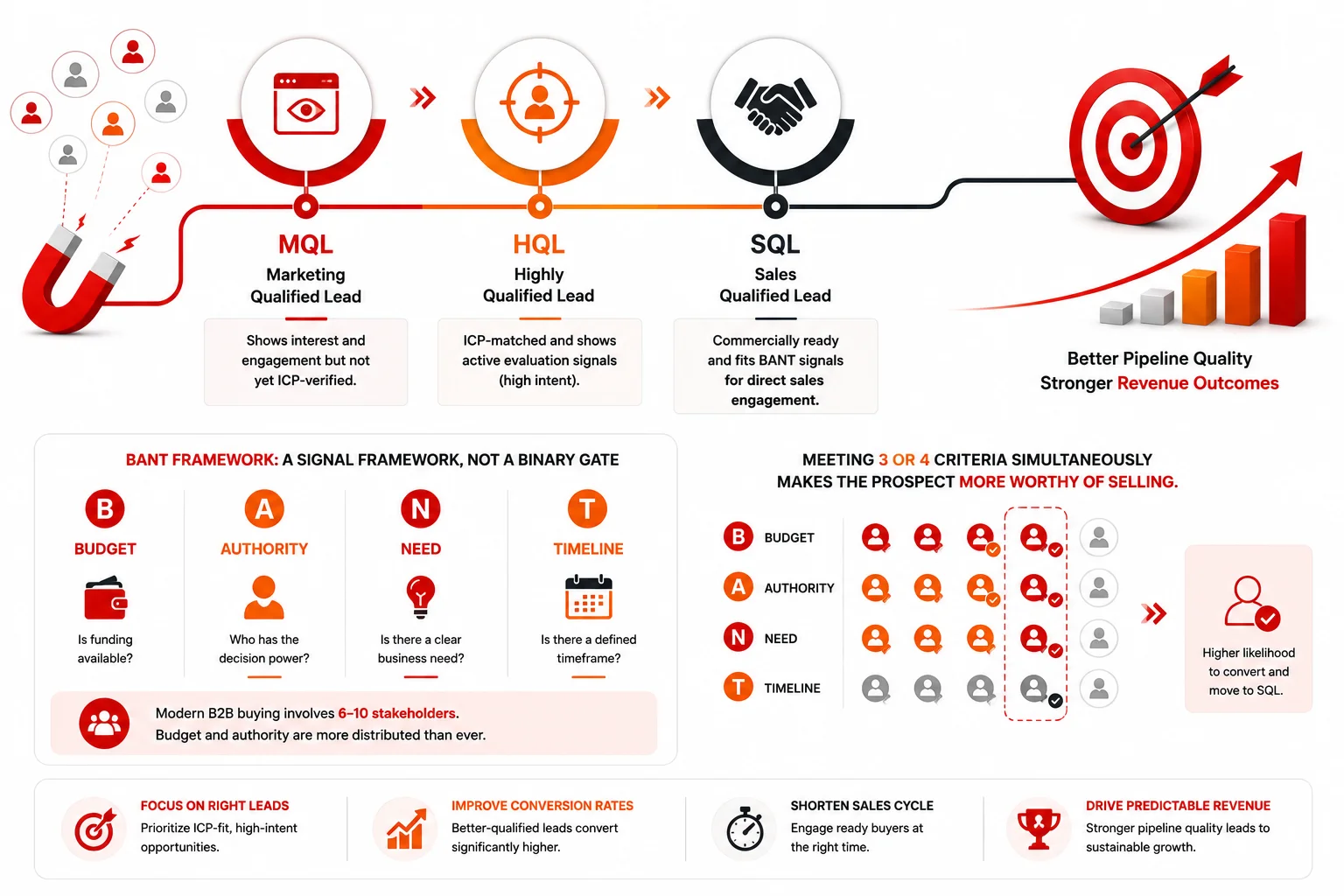
While a marketing qualified lead (MQL) reflects sufficient engagement, it is not ICP-verified, and this is why the sales team rejects it. When ICP-matched leads reflect active evaluation signals, which can be tracked using tools offered by 6sense, an MQL becomes a highly qualified lead (HQL).
When the prospect reflects enough commercial readiness for direct engagement, HQL becomes an SQL. The HQL stage captures prospects that are too hot for nurturing, yet unprepared for sales, and this is why it becomes the most commercially valuable stage of the B2B qualification system.
What Is BANT and Why Does It Define the MQL-to-SQL Threshold?
IBM-introduced BANT (Budget, Authority, Need, and Timeline) framework was originally designed for a single decision-maker to validate readiness, but today’s decision-making committees have evolved.
Geisheker’s 2026 research finds that modern B2B buying processes involve 6-10 stakeholders, making budget and authority more distributed than before. Applying the framework rigidly often rejects high-intent early-stage buying groups.
Instead of treating it as a binary gate, the qualification matrix must be considered as a signal framework. Meeting three or four criteria simultaneously makes the prospect even more worthy of selling.
What Is the Difference between MQL and SQL?
Applying a sales response to an MQL is the most common qualification failure mode. B2B enterprises that do not define rules for how leads move through different stages often create subjective disagreements among them.
| Parameter | MQL | HQL | SQL |
|---|---|---|---|
| Ownership | Marketing | Sales and marketing | Sales |
| Primary AI Signals | Engagement | Intent | BANT validation |
| ICP-fit | No | Yes. Firmographic fit. | Yes |
| Sales Readiness | No | Not yet, needs acceleration | Yes, completely. |
| CRM Owner | Marketing team | Marketing handoff to SDR | Sales team |
| Primary Action | Nurture the sequence | Accelerate the content and SDR outreach | Pipeline entry and discovery call |
| Key KPIs | MQL-to-HQL rate | HQL-to-SQL rate | SQL-to-Opportunity rate |
| Examples of AI Tools | Pardot scoring and Marketo | Demandbase and 6sense | Salesforce Einstein and Gong |
What Is Lead Scoring, and How Does It Work?
High lead scoring often does not imply high quality. Scoring frameworks that prioritize no-engagement signals only produce high-scoring cold leads. While scoring automates signal accumulation, qualification rules explain the meaning of those signals.
Before configuring, criteria on which models are trained must be defined jointly, and tools like HubSpot, Pardot, and Marketo monitor scoring mechanics. Which signals receive weightage determines how good lead scoring becomes. Ideally, active metrics should weigh 3-5 times that of passive engagement metrics.
The real commercial signal lies in what prospects evaluate instead of the content volume they consume. Reducing passive engagement and increasing active buying signal weight can result in immediate and the most effective improvement in the scoring model.
How Buyer Intent Affects Lead Qualification in the B2B Sales Funnel?
When first-party intent signals are integrated with third-party signals, collectively they produce a complete buyer intent picture. While the contact reflecting high third-party intent with no first-party engagement is an untapped MQL, the prospect showing both is often an HQL.
Wyzard’s 2025 report finds that B2B enterprises that integrate intent data while scoring leads boost their conversion rate by 2-3x. However, only if intent data updates the qualification benchmark does it become valuable.
Buyer intent surfaces commercial readiness before the contact is visible to revenue teams, and thus, it is the earliest leading indicator in the lead qualification framework.
What Is the Role of AI in Lead Qualification and MQL-to-SQL Conversion in 2026?
Although AI enhances the quality of qualification criteria, poorly defined MQL benchmarks with AI scoring at the top often generate faster and automated bad lead handoffs. The following AI applications can transform qualification workflows:
- Dynamic Threshold Adjustment: It recalibrates HQL and MQL thresholds depending on historical conversions.
- Predictive Lead Routing: Using behavioral scoring, it matches patterns to predict the subsequent stage.
- Qualification Decay: Instead of leaving stale MQLs in the pipeline, it automatically downgrades cold contacts. Qualification decay cleans the pipeline without manual intervention, and that is why it is the most commercially valuable AI function.
What Are the Best Practices for Improving MQL-to-SQL Conversion and Lead Handoff Quality?
MQL to SQL conversion rate often produces an incomplete pipeline picture, but the SQL-to-conversion rate offers complete information. Most B2B teams hardly run the monthly MQL rejection audit, which produces the highest-ROI qualification improvement activity.
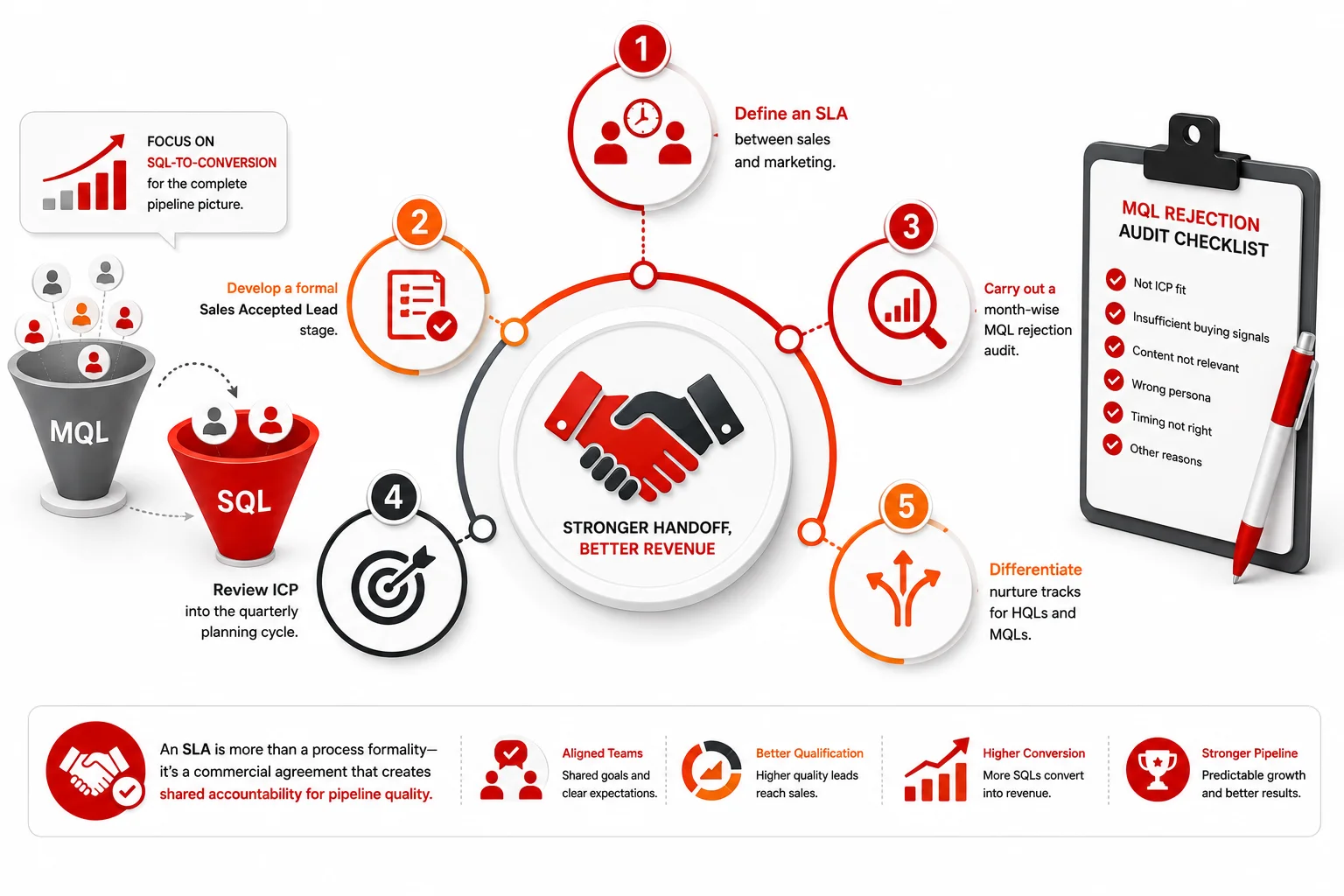
The following five practices surely improve the MQL-to-SQL conversion rate:
- Define an SLA between sales and marketing.
- Develop a formal Sales Accepted Lead stage.
- Carry out a month-wise MQL rejection audit.
- Review ICP into the quarterly planning cycle.
- Differentiate nurture tracks for HQLs and MQLs.
Beyond just a process formality, an SLA between sales and marketing is a commercial agreement, shifting lead qualification criteria from sales handoff to a structure of shared accountability.
What Are the Most Expensive Common Mistakes in Lead Qualification?
Over-qualifying is a bigger mistake than under-qualifying because nurturing HQL during a closing buying window costs more than passing on an under-qualified MQL for sales discovery. According to Land Base, improper lead qualification results in 67% of lost sales.
Here are the four mistakes that further erode the pipeline:
- Measuring MQL volume to monitor marketing success.
- Treating BANT as a binary gate.
- Using the same qualification rules across every segment.
- Not auditing the qualification framework used.
An unaudited qualification threshold worsens every quarter, because ICP shifts, while the criteria do not change. Monthly rejection audits and quarterly criteria review can spot predictable patterns that qualification errors produce in just a single cycle.
Key Takeaway: How Does an MQL Become an SQL, and What Happens After an SQL?
More than a taxonomy debate, the difference between MQL and SQL and HQL is an operational architecture determining the efficiency of marketing investments that convert into closed deals.
B2B enterprises that define precise qualification criteria, audit scoring models regularly, and have the most disciplined handoff SLAs often produce the highest MQL-to-revenue conversion rates.
Instead of adhering to only a marketing workflow, lead qualification has transformed into a revenue system. Marketboats can help you build a strong qualification framework that transforms lead nurturing and sales pipeline into a revenue engine.
Frequently Asked Questions About MQL and SQL
1. What is MQL?
A prospect that shows engagement signals through content download, website visits, or webinar attendance so that it meets marketing’s predefined qualification threshold is called a marketing qualified lead or MQL.
2. What is SQL?
A prospect that completes sales validation thresholds by meeting ICP fit, commercial readiness, and buying intent to be accepted for active pipeline development by the sales team is called a sales qualified lead or SQL.
3. What is the difference between MQL and SQL?
The core distinction between the two lies in sales readiness. While MQL demonstrates marketing engagement, SQL reflects prospects qualified for direct sales conversations based on stronger buying signals and qualification criteria.
4. Can an MQL become an SQL directly?
Yes. However, this is not always recommended. Many B2B enterprises implement an HQL stage between MQL and SQL to validate buyer intent before routing prospects to sales. This enhances pipeline quality by reducing SQL rejection rates.
5. Which KPIs measure lead quality?
Sales cycle length, HQL-to-SQL conversion rate, MQL-to-HQL conversion rate, SQL-to-Opportunity conversion rate, win rate, pipeline contribution, and sales accepted lead (SAL) rate are some important KPIs that measure lead quality.